
Market Recap
By Tim Senechalle, CFA

Capital markets in the second quarter were shaped by steady economic growth, a respite from the conflict in the Middle East, strong corporate earnings, and the beginning of the ’Warsh’ Fed.
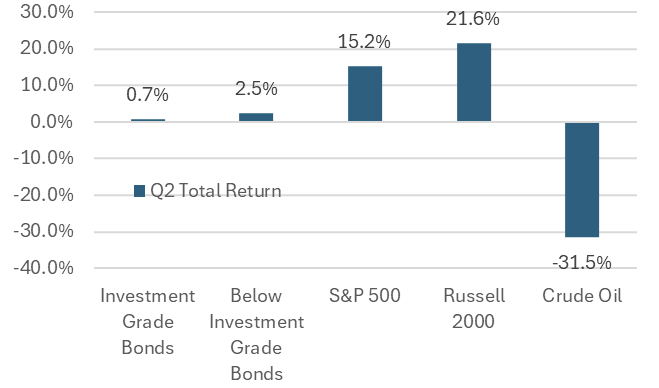
These factors coincided with positive performance across markets, with positive excess returns in high-grade and high-yield fixed income and double-digit price gains for equity markets.
We anticipated a healthy underlying economic backdrop – despite the strain of high oil prices – and a constructive investment environment for credit and equity markets. Our forecast for interest rates and Fed policy, however, proved too dovish. Even so, we benefited from investment themes that prioritized yield and spread in short maturity bonds, selectivity in the technology sector, and diversification across equity markets.
In the sections that follow, we look back at these second quarter performance drivers — with perspectives on the macroeconomic environment, fixed income market dynamics, and stock valuations — and share our outlook for portfolio positioning as we head into the second half of 2026.
Sources: 1. Bloomberg, Bloomberg fixed income Index series data through 6/30/2026.
Economic View
By Marco Bravo, CFA
The U.S. economy carried solid momentum through the second quarter even as the conflict between the U.S. and Iran continued to dictate the path of energy prices. Repeated disruptions to traffic through the Strait of Hormuz kept oil volatile, with Brent swinging from roughly $70 to above $90 per barrel as the ceasefire alternately held and frayed, lifting headline inflation. Core goods deflation over the past two months and decelerating shelter costs have muted the pass-through to core prices. Consumer spending has remained resilient, supported by a stable labor market, rising household wealth, and tax refunds associated with the OBBB, though late-stage delinquencies among lower-income households point to a widening divide in consumer health. Payroll growth has slowed for three consecutive months, but with the unemployment rate holding near 4.2%, the labor market is better characterized as low-hire, low-fire than deteriorating.
Looking to the balance of the year, AAM is cautiously optimistic on growth, with risks broadly balanced. Consensus real GDP growth near 1.9% appears reasonable, supported by AI-related capital spending, now expected to exceed $1 trillion in 2026, and steady consumption, while a renewed increase in gasoline prices remains the principal downside risk. We continue to view risks to core inflation as skewed to the upside. Consensus core PCE of approximately 3.2% for the fourth quarter reflects energy pass-through, tariff effects, and AI-driven pressure on hardware and memory costs, and we do not expect a meaningful decline in core inflation this year. With inflation elevated and the labor market steady, we expect the Federal Reserve to remain on hold through 2026, and view the next policy move as more likely a cut in 2027 than a hike, with a sustained oil shock the primary risk to that view. We expect the Treasury curve to remain range-bound at higher levels, with the 10-year yield ending the year between 4.15% and 4.65%.
Fixed Income Market
By Elizabeth Henderson, CFA
Fixed income markets delivered solid results during the second quarter as Treasury yields moved lower and credit spreads remained relatively contained. April volatility surrounding trade policy and economic growth concerns gave way to improved sentiment as inflation moderated and labor markets remained stable. Investment-grade corporates benefited from resilient fundamentals and strong demand, while securitized sectors continued to offer attractive relative value. Performance across sectors remained dispersed, reinforcing the importance of selective security positioning and fundamental credit research.
Within spread sectors, investment-grade corporate bonds generated favorable excess returns despite historically tight valuations. Securitized assets, including ABS, CMBS, and non-agency RMBS, continued to benefit from strong fundamentals and attractive spreads relative to similarly rated corporate bonds. Agency mortgage-backed securities participated in the rally as rates moved lower, though performance remained influenced by prepayment and convexity considerations. Overall, markets were supported by healthy demand, active new issuance, and a backdrop that remained favorable for income-oriented fixed income investors.
AAM Fixed Income Performance
By Elizabeth Henderson, CFA
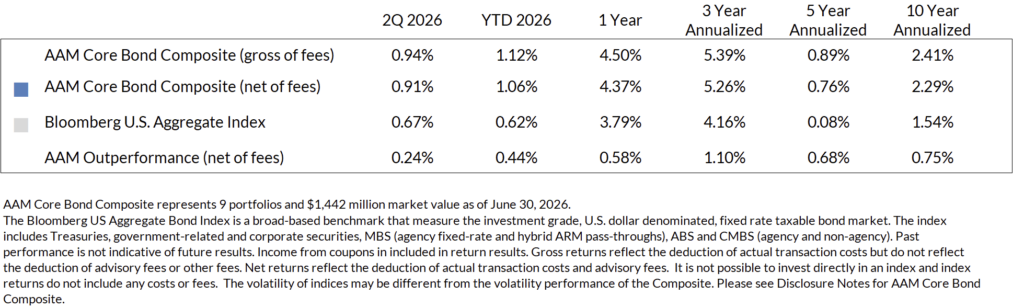
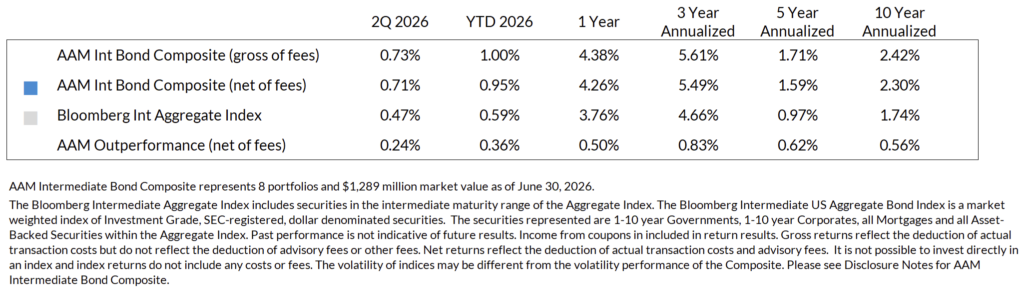
AAM’s Core composite outperformed the Bloomberg Aggregate during the second quarter of 2026, with results driven by a combination of sector allocation and security selection across the curve. Excess returns were positive in every duration bucket, reflecting the breadth of contribution from both positioning and issuer selection. On the short end of the curve, security selection within Banks, ABS, and non-agency CMBS, together with an overweight to cyclical sectors in Corporates, more than offset the underweight to higher-coupon Agency pass-throughs which performed well as interest rates continued to increase. In the belly of the curve, security selection was particularly strong in Industrials, ABS, and CMBS. Finally, on the long end, security selection in Corporates added value, as did the allocation to taxable municipals, both of which outperformed comparable U.S. Treasuries. Positive contributions across all segments of the curve demonstrated that the portfolio’s excess return was broad-based rather than concentrated, underscoring the benefits of a diversified approach to identifying relative value in less index-efficient areas of the market.
AAM Core Bond Composite
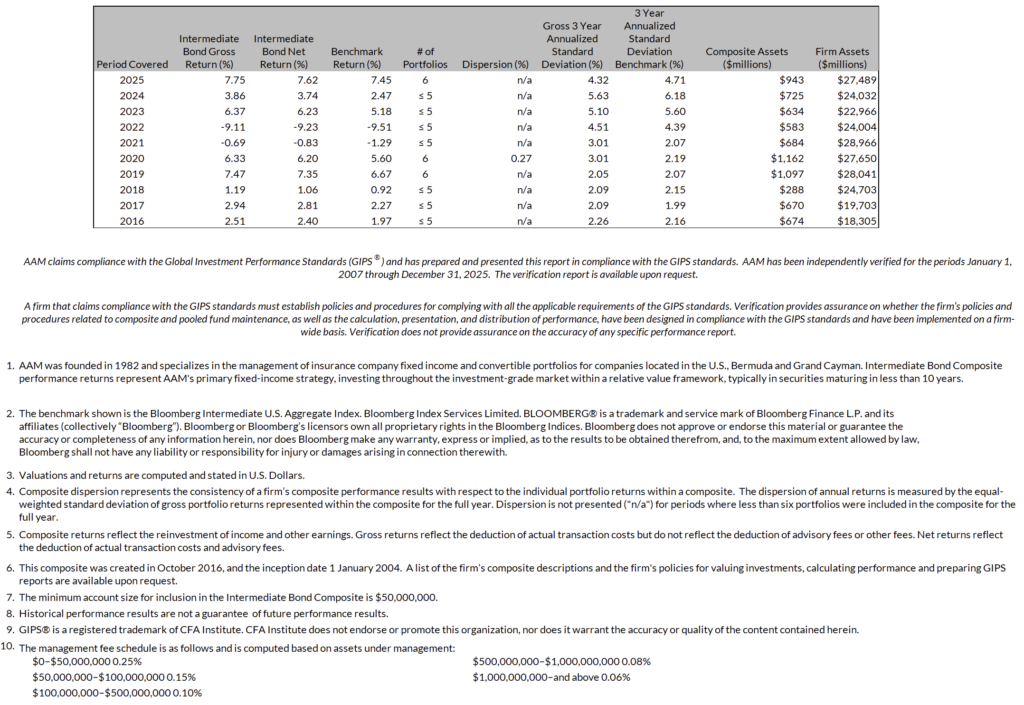
AAM Intermediate Bond Composite
US Equities: A Q2 Rebound and Broadening of Performance
By Peter Wirtala, CFA
Q2 was one of the strongest quarters in years for equity markets. After a first quarter unsettled by the Iran conflict and oil briefly near $115 per barrel, a ceasefire framework took hold, crude round-tripped back toward $70, and risk appetite quickly revived. The S&P 500 returned 15.2% — its best quarter since 2020 — recovering the first quarter’s decline and finishing the first half up roughly 10%.
Crucially, these returns were fundamentally driven. S&P 500 earnings growth is estimated at 23.3% for the quarter, and analysts raised estimates during the quarter rather than trimming them — a break from the twenty-year pattern. Nine of eleven sectors advanced. With the index multiple essentially unchanged, nearly all of the year-to-date performance came from earnings rather than multiple expansion — a healthier composition of return than we’ve seen in many recent quarters. Notably, the Magnificent 7 lagged while their suppliers captured the benefit of ongoing, elevated capex. Small and mid-capitalization companies and international indices all outpaced the S&P 500 for the first half, and industrials, financials and healthcare all performed well as the quarter progressed. For diversified index portfolios, this is the first quarter in some time that has genuinely rewarded breadth.
Source: Bloomberg, LPL Research, Schroders, Nasdaq. Total returns for the quarter ended 6/30/26.
Outlook for Insurance Portfolios
Public Fixed Income
Fixed income markets are entering a period of change on two significant fronts, both of which may increase volatility and materially impact portfolio performance.
First, ongoing inflation concerns and renewed conflict in the Middle East have put upward pressure on benchmark yields. Compounding this is a shift in supply and demand dynamics, as increased spending across public and private sectors is driving accelerating debt issuance across numerous market segments – a theme that our team highlighted earlier this month (Corporate Fundamentals 2Q2026) .
Second, changes at the Federal Reserve under new Chair Kevin Warsh have coincided with a steepening yield curve as the market adjusts to reduced forward guidance. Notably, market-implied inflation rates, as indicated by the TIPS market, have remained stable while nominal rates have increased. This suggests an increase in the term premium, driven by policy uncertainty and the supply dynamics described above.
Together, these factors point to a higher-for-longer cycle for insurance company fixed income portfolios – a positive for future operating performance. Second quarter earnings releases from a subset of publicly traded property and casualty insurance companies highlighted acquisition investment yields of 5.0%-5.5%, an advantage of 60 to 90 basis points over existing portfolio yields. Companies with short duration portfolios and those generating positive operating cash flow stand to gain the most. For life and annuity companies, investment grade corporate bonds maturing in 10 years or longer now carry an average yield of 6.2%, offering multiple avenues to deploy capital in public markets at yields of 6.0%-6.5%.
Within fixed income markets, AAM’s investment team continues to see more favorable opportunities for excess return in securitized sectors than in corporate and municipal markets broadly. AAA- rated CLOs, for example, appear increasingly attractive for portfolios with short duration objectives. In longer maturities, we are pursuing targeted opportunities in the new issue corporate market which has benefited from new issue concessions. We are investing selectively from among the deluge of hyperscaler offerings, booking attractive yields while retaining flexibility to participate down the road in future offerings from quality issuers.
Source: Bloomberg index data as of 7/29/26. Industry yield figures sourced from earnings call transcripts (CB, DGICA, EG, RLI, WRB) the quarter ended 6/30/26.
Equities
We remain constructive heading into the second half, but with less room for error. Valuations are the main concern: several of the most historically predictive measures sit at or near all-time highs, and the top ten index holdings represent roughly double their historical share. Policy is the second. With core inflation above target and energy a persistent upside risk, our base case assumes no rate cuts this year, and the market has shifted from pricing cuts to contemplating hikes. Neither observation argues for reducing equity exposure — both argue against relying on a narrow group of mega-cap winners.
Disclosure Notes
AAM Core Bond Disclosure Notes
AAM Intermediate Bond Disclosure Notes


Corporate Fundamentals 3Q26; Exceptionally Unique Forces Driving Fundamental Strength & Concern
October 19, 2026