
Market Recap
By Tim Senechalle, CFA

Fixed income markets took center stage during the third quarter as interest-rate volatility surged and the higher-for-longer narrative became reality. The Federal Reserve embarked on a new rate hiking cycle at the September meeting and markets have materially re-priced expectations for the future path of rates.
As illustrated below, investors now expect 75 basis points of additional tightening with the target range for the overnight rate ending 2027 at 4.50%-4.75% (Exhibit 1).
Exhibit 1: Fed Funds – Dec 2027 Futures Implied Rate
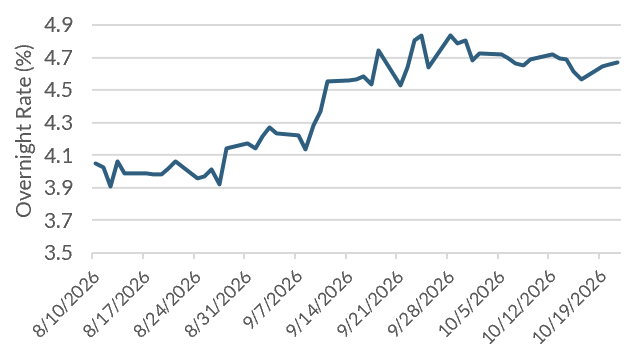
Source: Bloomberg L.P. data through 10/20/2026.
Amid heightened rate volatility, markets generally exhibited stable performance. Considering the significantly increased cost of capital for sovereign, consumer, and corporate borrowers relative to early 2026, market performance has been comparatively resilient. We note, however, weaker returns in several rate and volatility sensitive areas:
- Speculative quality credit with ‘CCC’ quality underperformance
- Fixed rate MBS where prepayment sensitive MBS widened
- Tax-exempt municipal bond markets where fund flows shifted
- Equity markets with small cap share price declines during Q3
In the sections that follow, we dig deeper into the drivers of third-quarter market performance, including favorable macroeconomic conditions and strong corporate fundamentals, and provide our perspective on the path for markets for the final quarter of the year.
Economic View
By Marco Bravo, CFA
The U.S. economy has continued to perform well, supported by strong consumer spending and AI-related business investment, even as the conflict in the Middle East continues to influence energy markets. Middle East oil exports have nearly returned to pre-conflict levels thanks to bypass routes and U.S.-secured shipping lanes, but diesel supply remains constrained, and we remain skeptical of a quick resolution. Retail sales data have been positive, and higher gasoline prices have not meaningfully dented aggregate consumption, though lower-income households continue to bear a disproportionate burden. Wage growth has been flat and the savings rate has declined, but layoffs have not yet materialized; a turn in the labor market remains a key risk we are monitoring.
Looking ahead, consensus real GDP growth for 2026 has risen to approximately 2.4%, up 0.4 percentage points from a month ago, driven by AI spending and consumption supported by equity market gains. AAM expects growth to come in modestly above consensus, with downside risks from an equity market correction, higher interest rates and oil prices. Inflation remains elevated and we continue to view risks as skewed to the upside: core PCE stands at 3.0% year-over-year and is expected to average 2.8% over the next four quarters, well above the Fed’s 2% target, with oil and AI-driven demand adding pressure, partly offset by slowing earnings growth and mortgage rates above 7% weighing on housing and services. We expect oil to average about $86 per barrel in 2026 and $85 in 2027. Markets are pricing one more Fed rate hike this year, which we view as the most likely outcome, though a case for a pause remains. Rising 10-year yields may reflect investors seeking greater compensation for growing U.S. government debt, though the dollar’s reserve-currency status and the depth of the Treasury market remain significant advantages. Abroad, fiscal and political risks in Europe, particularly France ahead of its presidential election, warrant attention, though we do not anticipate an imminent crisis. Against this backdrop, we believe risk assets leave limited room for downside surprises.
Source: Bloomberg data as of 10/16/2026
Fixed Income Market
By Elizabeth Henderson, CFA
Fixed income markets faced a more challenging backdrop during the third quarter. In July, higher rates, a steeper Treasury curve, FOMC uncertainty, and broader global macro volatility weighed modestly on spread sectors, and total returns turned negative. Pressure intensified in August and September as a global bond selloff reflected concerns about heavy government borrowing, persistent inflation, higher energy prices, and the prospect of tighter-for-longer monetary policy. Treasury yields rose 40 to 53 basis points across the curve in September alone, and rate volatility remained elevated.
Despite the rate backdrop, investment-grade credit proved comparatively resilient. Corporate spreads held up well, with the Bloomberg Corporate Index ending September at an option-adjusted spread of 80 basis points and a yield to worst of 6.04%, and long corporates outperformed. CMBS and ABS continued to outperform, and floating rate product benefited as rates rose. Agency mortgage-backed securities were the notable laggard, as rate volatility drove one of the weakest Septembers on record for the MBS Index and extended index duration. With all-in yields at attractive levels since 2023, the backdrop remains favorable for income-oriented investors, though fundamental credit research remains essential.
AAM Fixed Income Performance
By Elizabeth Henderson, CFA
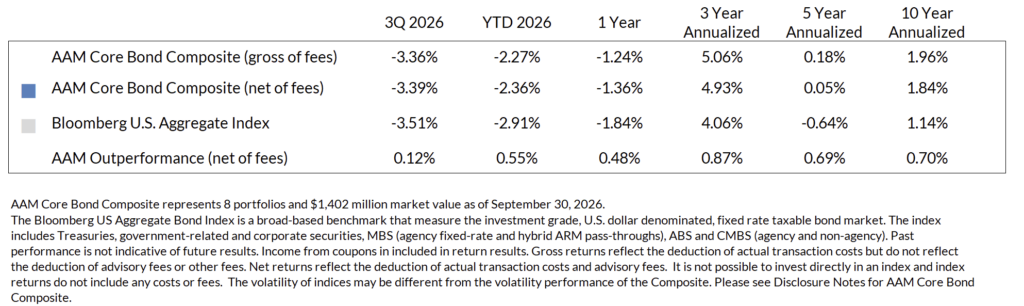
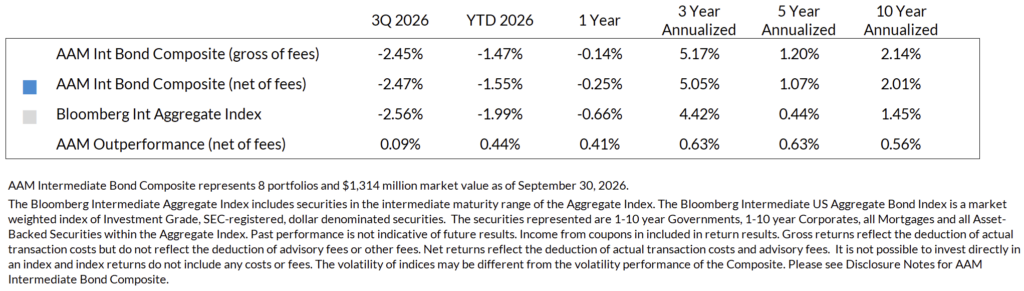
AAM’s Core composite outperformed the Bloomberg U.S. Aggregate Bond Index during the third quarter of 2026, with positive contributions from many sectors despite a volatile rate environment. Corporates were the largest contributor, driven by security selection across maturities, particularly in Banks, Technology, and Energy. CLOs, which are not included in the Index, added value as floating rate assets outperformed. In securitized sectors, security selection and an overweight to non-agency CMBS, security selection in esoteric ABS, and an underweight to Agency pass-throughs all contributed. An overweight to long taxable municipals also helped. These gains more than offset the drag from our underweight to U.S. Treasuries, which outperformed as yields rose. Unlike the broader market, the composite had no downgrades to high yield during the third quarter.
AAM Core Bond Composite
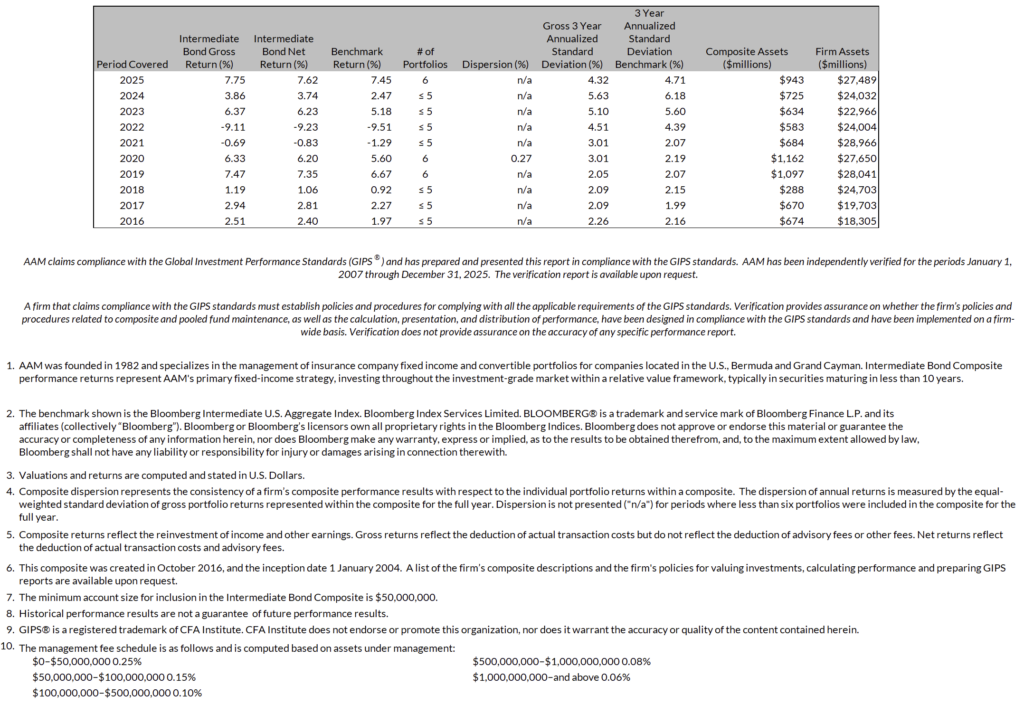
AAM Intermediate Bond Composite
Equities Keep Climbing, But the Road Gets Narrower
By Peter Wirtala, CFA
U.S. equities continued to advance in the third quarter, although investors had to navigate a much less forgiving environment than they experienced in spring. The S&P 500 returned 2.3% in Q3, bringing its year-to-date gain to 12.7%, while the Nasdaq Composite returned 2.6%. Smaller companies struggled, however, with the Russell 2000 declining 7.2% for the quarter.
The divergence reflects an important change beneath the surface. In the second quarter, we highlighted an encouraging broadening of equity-market leadership. That trend partially reversed in Q3. The equal-weighted S&P 500 fell 1.9%, even as the cap-weighted index advanced, and by quarter-end more than 60% of S&P 500 companies were trading below their 200-day moving averages.
The primary challenge was interest rates. Resilient economic activity, persistent inflation and renewed energy-price pressures pushed Treasury yields sharply higher, with the 10-year Treasury ending September around 5.3%. Rising yields placed particular pressure on smaller companies and other rate-sensitive areas of the market, while investors continued to favor businesses capable of delivering strong earnings growth despite higher financing costs.
That earnings resilience remains the strongest argument supporting equities. Corporate results continued to exceed expectations, including particularly strong second-quarter earnings reported during Q3. The durability of economic growth, continued AI-related investment and healthy corporate profitability helped equities absorb a rise in interest rates that proved much more disruptive to fixed income markets. At AAM, our current economic view similarly identifies AI investment and consumer spending as important supports for growth, while viewing recession risks as relatively low.Looking toward year-end, we remain constructive, but increasingly selective. Economic growth and corporate earnings continue to provide meaningful support, while elevated interest rates, energy prices and increasingly uneven market breadth argue against simply extrapolating recent index returns. After several years in which investors were rewarded for concentrating in the largest growth companies, the next phase of the cycle may place a greater premium on diversification, valuation discipline, and patience.
Source: Bloomberg, Total returns for the quarter ended 9/30/26.
Outlook for Insurance Portfolios
Fixed Income
For insurance investors, the higher-rate environment introduces opportunities and challenges. The rising tide of investment yields continues to support investment income growth across the industry as insurers reinvest portfolio cash flow and premium revenue at higher prevailing rates. While we had anticipated a flattening profile in book yield accretion earlier in the year, current market rates offer tailwinds for companies able to deploy capital.
At the same time, rising yields mean falling prices for existing bonds and an amplification of unrealized losses embedded within insurance company portfolios. This creates an inherent tension for insurers wishing to invest in high-quality, yield-oriented opportunities but facing limited flexibility to fund new investments. With numerous investment grade sectors continuing to trade at historically tight spread levels, finding creative ways to transact is an important strategy for value creation – a theme highlighted by our team during the third quarter (Budgeting Losses Can Buy Wins).
Finally, higher rates will place greater pressure on borrowers while creating opportunities for discerning lenders. We believe that this environment will increasingly reward investors that have properly underwritten credit risk, can anticipate future supply and demand imbalances, and have the expertise to identify and pursue targeted risks across public and private markets.
Higher yields alone will not produce the same outcome for every insurance portfolio. The ability to deploy capital, underwrite risk, and selectively reposition existing assets should increasingly determine which insurers benefit most from a higher-for-longer environment.
Equities
Looking ahead to year-end, we remain constructive, but increasingly selective. Economic growth and corporate earnings continue to provide meaningful support, while elevated interest rates, energy prices and increasingly uneven market breadth argue against simply extrapolating recent index returns. After several years in which investors were rewarded for concentrating in the largest growth companies, the next phase of the cycle may place a greater premium on diversification, valuation discipline, and patience.
Disclosure Notes
AAM Core Bond Disclosure Notes
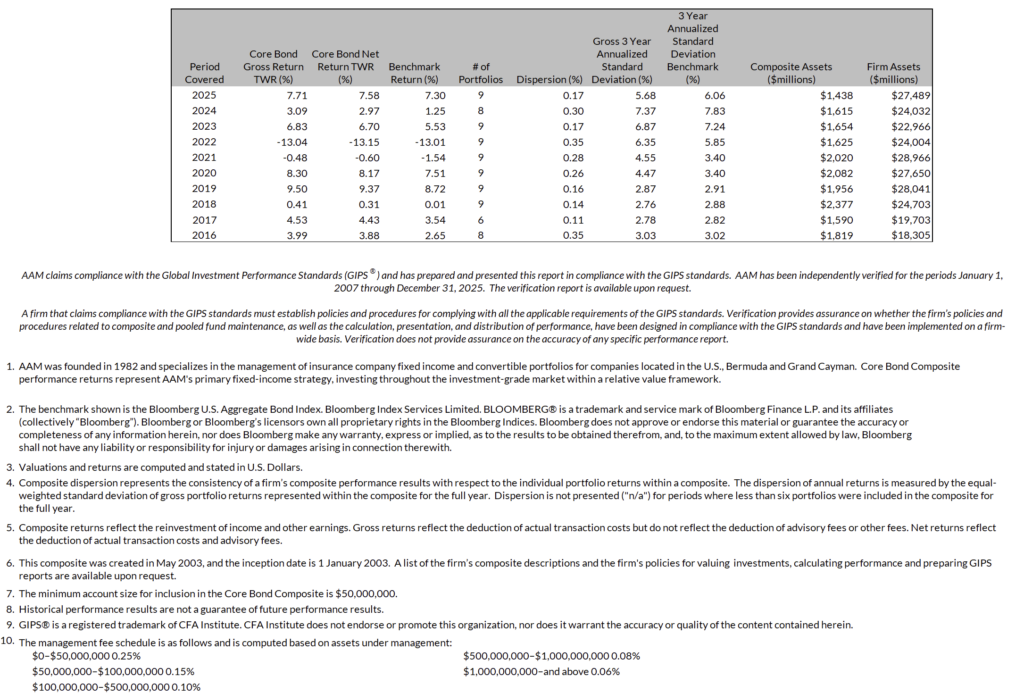
AAM Intermediate Bond Disclosure Notes


Corporate Fundamentals 3Q26; Exceptionally Unique Forces Driving Fundamental Strength & Concern
October 19, 2026